Category "Whizzkids"

19Mar2019

In a few weeks, 5-year-old Benny Parnitzke will be off to kindergarten at Millennium School in Tinley Park.

He recently took a break from summer fun and loading supplies into his Star Wars backpack to offer a few words of advice for those following in his footsteps.

“Always wash your hands. Take turns with toys. Use manners at snack time,” he said to 3- and 4-year-olds readying for preschool.

Those are just some of the life skills he learned while enrolled in the Tot Time Preschool Program offered through the Tinley Park-Park District.

His mom Colleen Parnitzke said her son also learned colors and shapes, as well as how to distinguish his left hand from the right, how to count to 100 and how to ask for help without whining.

In addition to grasping social skills, such as how to take turns, control impulses and not invade other people’s space, Parnitzke said, so important from a parent’s standpoint, “He learned he’s important. Those teachers made it a goal to make sure each kid felt important, that their questions and their ideas mattered.

“You could see his confidence grow” throughout the school year, she said.

Though there are many advocates for preschool these days, Parnitzke, a teacher at Homer Junior High in Homer Glen, said there are still some parents who are reticent to enroll their youngsters in a pre-kindergarten program.

“I know parents who don’t see the value of it. But I really truly think the earlier kids can start to recognize other people’s feelings, their own feelings, taking turns, working in a group, listening to adults and to their peers, the better,” she said.

In addition to the academic benefits, she said, starting school early can make a child feel a part of the community he lives in.

“They see other kids at the grocery store or at the park and they feel like they belong,” she said.

Tot Time teacher Mary Walsh said, “They’re saying kindergarten is the new first grade. It’s more academic and much different than it was 10 years ago.”

That’s why it’s not unusual for children to be introduced to academic skills such as printing and counting in preschool, she said.

Though children can enter preschool at all different levels, Walsh said, teachers hope they leave at the end of the year with a clear understanding of important social skills, such how to share, how to make friends and how to be excited about learning.

“These are important skills for everyday life,” Walsh said.

What is the best way to prepare your child for that first school adventure?

Talk it up, drive by the building and “always be positive,” said Kathleen Sheeran, a preschool teacher at Mary Sears Childcare Academy in Orland Park.

“If the child is giving anxiety feedback, come back with something positive. Say ‘I can’t wait to see what you’re going to make me’ or ‘You’re going to make new friends and love your teacher,’” Sheeran said.

Preschool enables youngsters to learn social skills and the rules of play, as well as how to converse with others, how to learn from another adult and how to get comfortable in a school setting, she said.

“And with the way our education is today, you’re expected to know a lot by kindergarten,” she said.

Sonia Sierocki, a preschool teacher at Koraes Greek-American Parochial School in Palos Hills, said every child’s school experience should begin with positivity on the part of parents.

“Reassure them that you love them and that they’re going to have so much fun and that you’ll be back soon. And then leave — quickly,” Sierocki said.

“A lot of times parents want to linger. That makes it really hard for kids. They see their parents’ eyes watering and they get scared,” she said.

The teachers, she said, know how to handle even the saddest child.

“They’ll reassure them and get them involved in an activity. Once they get busy, they’re fine,” she said. “Our first two weeks are going to be accommodating them. We’re ready for criers, kids who want to run. So the first few weeks we go over rules and get them used to being around other kids and make them comfortable.”

The best way for parents to prepare their child for preschool, Sierocki said, is to teach them their first and last names and how to hold a pencil or crayon.

“We can do the rest,” she said.

And “the rest” can be considerable, she added.

“Nowadays, there’s a whole list of things they need to know coming into kindergarten,” she said. “If they don’t go to preschool, that puts a lot of pressure on the parents.”

Parnitzke enrolled Benny is a pre-preschool class called On My Way.

“It helped so much,” she said. “It gave him a feeling for what it’s like to walk into a classroom without having to stay there too long.”

She also taught him her phone number.

“That made me more relaxed,” she said. “He could read his name and he could say Mommy’s phone number.”

Now that he’s a veteran, Benny can offer insider tips for newbies.

“Make sure you wait in line nicely,” he said. And, lastly, “Be good.”
18Mar2019

Education’s increasingly narrow focus on tests and targets overlooks play’s harder-to-measure contributions to child development.

Policymakers should stick with play as an educational priority even though the importance of play in child development is sometimes hard to measure and, hence, difficult to defend.

They shouldn’t be seduced by increasingly narrow approaches that threaten to diminish the importance of play in child development. An overreliance on high-stakes testing sometimes fails to recognize the potential of play’s sometimes mysterious but obviously vital role.

There are three reasons – some barely appreciated – for emphasizing play in child development. First, play can unlock children’s diverse ways of learning. Second, it helps to develop learning outside the classroom. Third, play may have an important role in reducing crime.

Learning through play highlights different pathways to child development

Children, through their many forms of play, mark out alternative paths to learning and, hence, child development. The diversity of ways to learn is clear from the wide cultural variations in early play. ‘One size does not fit all’ is play’s message to learning. There is no universal theory of child development, demonstrates Jaipaul Roopnarine, one of the seven leading play researchers who has contributed to the Child and Family Blog. Roopnarine contrasts, for example, the highly involved play practices of ‘helicopter parents’ and ‘tiger moms’ in some societies with the attitudes of Mayan mothers in Guatemala who see play as perfunctory to childhood development.

Individual children take different play paths, guiding their learning through play that is most appropriate to their capacities and potential. They cleverly avoid what they already know or might find too difficult to understand, demonstrates Celeste Kidd. Her fascinating eye-tracking studies with babies show how smart they can be in their seeming distraction. Their play patterns provide vital information about what children already know or can easily learn.

“Don’t be seduced by approaches that threaten to diminish the importance of learning through play.”

On the other hand, there remains considerable uncertainty about the precise value of certain forms of play, following Angeline Lillard’s debunking of contemporary beliefs that extra pretend play builds cognitive skills and creativity. Lillard could find no reliable evidence for this common belief. Her findings suggest when learning through play is rooted in real life, it is more beneficial to child development than, for example, play with toys.

Yet Lillard’s findings don’t mean that childhood imaginative play should be condemned to irrelevance. Imaginative play is everywhere, a marker of humanity, and it goes on throughout life, as Paul Harris points out. It clearly remains important, he says, despite our incomplete understanding of its mechanisms.

Learning through play occurs outside school

Amid the debate about the importance of play in child development during early years’ education, many have remarked on its disappearance from public spaces. That loss is being addressed in exciting new ways. Kathy Hirsh-Pasek and Roberta Golinkoff show, in their work, how developing supports for outdoor play – on sidewalks, supermarkets, even bus-stops – can create innovative opportunities for learning.

Indeed, schools would be wise to pay attention to this exemplary of learning through play that is emerging out in the streets. Early evidence suggests that the playful learning being developed in the Learning Landscapes projects may hold great potential, in particular, for tackling educational inequities.

“Be wary of relegating learning through play any further from formal educational settings.”

Fathers – and their forms of play – are also allies in challenging such social injustice, finds Natasha Cabrera. Her work has established that play with dad can help bridge cognitive, social and emotional learning gaps between low-income children and their better-off peers. Cabrera points out that low-income dads are often extremely good at the challenging wh-question communications which so benefit children’s cognitive development. They can also be very good at the rough-and-tumble play that supports children’s social and emotional learning.

Play is correlated with reduced crime

 There is a powerful criminal justice argument for promoting childhood play. Specifically, deprivation of play in childhood is correlated with later convictions for violent, antisocial activities. According to Stuart Brown, murderers typically have no memory of ‘normal’ childhood play. “Bullying and inappropriately acted out aggression was their ‘play’ patterns,” Brown explains in his reflections from a career that has examined 6,000 individual play histories.

Taken together, these experts’ contributions create compelling perspectives on the importance of play in child development. At a very basic level, play can encourage children to stay in education. Educators often comment that creative play – particularly through arts subjects – can support regular school attendance, especially among disadvantaged children, who may be particularly prone to feeling alienated by dry over-concentration on core curriculum subjects.

Be wary, then, of tests and targets that threaten to push learning through play any further from formal education. The rigidity of these institutional environments may sometimes result in the very opposite of what they set out to achieve.

15Mar2019

If you’ve got one under five, you’re stretched.
If you’ve got two under five, you’re beyond capacity.
If you’ve got more than two under five, well, living in the South, I’ll simply say, “Bless your heart.”

My boys are almost two and four. I’m just beginning to emerge from the fog of baby years and enter the throes of two rough and tumble little beings attempting independence. Most of the time, I feel like we’re making up this parenting thing as we go. But there are a few survival tools I’ve gathered for the days I’m barely keeping my head above water.

1. Appreciate what’s working.

Every kid will provide unique frustrations in each season. My underweight three-year-old, for instance, can go days without expressing hunger. We’ve been through specialists, nutritionists, and feeding therapy. Meals are tough. When the scales show he’s down half a pound and I want to tear my hair out, I have to remind myself that this is only one piece of who he is. Despite the slow growth, he’s healthy. He sleeps a solid 12 hours at night and takes a good nap every day. He’s curious and articulate. Chances are that when your preschooler is driving you nuts in one area, something else is working so well you rarely even think about it.

2. Find your people.

I don’t care whether you’re an extrovert or introvert, whether you’re a working parent, or stay-at-home parent. You need at least a couple other parents in your corner who can laugh and cry with you and tell you that no, you’re not the only one whose formerly sweet 18-month-old can turn into a howling, temperamental beast at the drop of a Mega Blok. If you don’t have people right now, be bold. Make the first move and invite a family from preschool or church or the park over for a fine dinner of . . . well, probably chicken nuggets on paper plates.

3. Refuel.

I’m preaching to the choir here. Once the kids are in bed, my Type A response is a frenzy of meal prep and cleaning while I put my brain on autopilot with Netflix as my companion. I’m slowly learning ways to instead structure a time in my routine to actually be still and refuel–like walking the dog at night or listening to the Bible in the morning while I’m getting ready.

Those are just a few ways that I’m surviving the preschool years.

11Mar2019

Parents boost language development in early childhood by naming what children see, touch, smell, taste and do as they play.

What do you see, watching young children wander from one object to another, feeling, holding and playing with whatever they find of interest? In a single hour, toddlers will typically touch around 100 different objects, spending just 10 seconds, on average, playing with each.

In this whirlwind of exploration, I see a huge opportunity for adults. Children’s play offers a chance for them to name and describe what catches their children’s attention. In this way, they can support language development and foster the basic building blocks for literacy, maths and socio-emotional skills. Any parent can do it, but many don’t recognize the benefits that talking can offer.

Parents — and even some educators — mistakenly regard a child’s foraging play as frivolous. Instead of perceiving a wonderfully exuberant, exploring, learning child, some adults worry that their young children are inattentive, too easily distracted, and lacking in concentration.

Some parents will try to persuade their busy two-year-olds to keep playing with the dolly or the building blocks, concerned that toddlers should already be able to meet the requirement for school-age children to sit still and regulate themselves emotionally and behaviorally. They may even fear – as a child moves from one object to another – that this wandering signals the beginnings of eventual failure in the class. Sadly, some adults may be happier when children are sitting quietly in front of a screen. In that case, parents may imagine that their children are actively engaged. But, in fact, they are simply mesmerized and not learning much at all.

It’s time to revive the ideal of exuberant children and work alongside them to foster language development in early childhood.  When toddlers wander through space, carrying and fingering things, moving from object to object, they are learning so much about how objects feel and work, and about what they can do to manipulate them or create imaginary play scenes.

“It’s time to revive the ideal of exuberant children … as children engage in different types of play, what they hear from adults can promote specific skills and language development in early childhood.”

Children are also exercising self-agency. Often, they don’t choose toys. Children love to swing doors, press buttons on electronic devices and bang pots as well. Anything can become an object for play. In affluent homes, young children certainly play with an abundance of toys. However, they spend around 40 percent of their time playing with ordinary household items – remote controls and toilet paper are such fun toys!

Support language development in early childhood

As children play in different ways, what they hear from adults can promote specific skills and language development in early childhood.  For example, when children pretend play – feeding a teddy, say, or putting it to bed –a parent might join in with a supportive narrative. ‘Teddy is hungry – why don’t you feed him,’ mom or dad might ask.  Or they might say: ‘Teddy is tired – is it time to put her to bed?’

language development in early childhood

By using internal and mental state words, pretending teddy is hungry or tired, parents help their children appreciate the emotional states that underpin actions, scaffolding children’s understanding of other people’s minds and thoughts. These actions help to develop vital social and emotional skills.

Such contingent, responsive conversation from adults—labelling, describing and talking about what interests the child in the moment—has an important impact on language development in early childhood. The process needs attuned, talkative parents. But it also requires freedom for inquisitive, searching children to forage and explore lots of things in the environment during their play. A child who never picked up a candle or a pillow or a spoon would be less likely to hear and therefore learn the words for these objects.

Language development in early childhood helps maths and literacy

When children play with puzzles and blocks, they are likely to hear language for counting and for moving objects: “Put it on top … it’s fallen down … place it next to … behind … around”. Such prepositional phrases are spatial, relational terms that support the development of maths skills. And they all arise from children playing with, and talking about, different objects.

Likewise, play and adult engagement helps children learn verbs. Think of all the actions that could be involved with play –for example, turn the knob, press the button, throw the ball, or pull the string. As children manipulate objects and adults respond by labeling possible actions, a vocabulary rich with verbs naturally grows.

Research has sometimes lacked insight into these processes of language development in early childhood. When studying play, researchers tend to give children and their parents some toys and then film their interactions to observe how well the parents are attuned to their children. But these studies have taken place in contrived settings, where parents and children have little else to do besides play with the toys in front of them. We’ve not followed little children in their daily lives to understand what they do in their everyday environments. We have few norms for how children interact with objects under conditions that aren’t artificial.

“Follow the child’s lead. Name the objects that the child touches and find words to describe their actions.”

Lacking a real understanding of what’s OK for young children, I sometimes find, well-off parents, worry because, instead of sitting still and playing with his toys, their 15-month old likes to wander off and try different activities.  Parents should not expect toddlers to act like five-year-olds. Sitting still is not developmentally appropriate.

Moving around a lot is evolutionary and adaptive for toddlers and young children. It fits what we know from neuroscience, which shows that synaptic connections grow rapidly in early childhood. These connections will be pruned back in later years as children become more focussed. Adults should talk to toddlers and young children about the objects of children’s play and follow the children’s lead, rather than forcing children to sit still.

Show parents how to support language development in early childhood

It’s important to get this message out to parents. I recently conducted research in the homes of disadvantaged families. I watched exuberant, exploring children touching different toys. But many of those children played amid adult silence. Their parents didn’t view children’s play as an opportunity for learning the language. As a result, the children weren’t exposed to valuable language inputs that might help them to connect words to their play actions.

Why not? Parents said their children were occupied and they were happy to let them be. That’s understandable for parents who may see their role as keeping children nourished and safe, and intervening only when children are unhappy. Those roles are paramount. Yet we should also help parents recognize the benefits of talking with children while they are playing. That play is not frivolous. It matters.

Easy for adults to give words to play

Our workshops with parents – which demonstrate how to include language in everything young children do – have been extremely successful. Some parents didn’t understand that children’s everyday activities during play offer valuable opportunities for children to learn the language. Once parents were shown this, they found it quite easy to talk about whatever their children were doing.

Such interventions are much simpler than the sometimes complicated child-rearing prescriptions that parenting programmes offer. Our message is straightforward – follow the children’s lead, be it at bath time or play time or during meals. Name the objects that the children touch and find words for their actions. Parents have the tools to do this. They just have to get the message.

4Mar2019
Your child’s turning 3! Discover the best types of birthday presents to buy your 3-year-old.

A third birthday feels like a graduation of sorts. Your toddler is becoming a preschooler — he’s feeding himself, talking up a storm, and getting ready to potty train (if he hasn’t done so already). This is the first year he will truly anticipate, understand, and revel in all the attention he’ll receive on his big day. Shopping for toys changes a lot once your child turns 3. All the toys with smaller pieces labeled “choking warning” are now safer for your child, so a whole new universe of play opens up. “Three-year-olds explore things with their hands instead of their mouths,” explains David Perlmutter, M.D., a board-certified neurologist and author of the book Raise a Smarter Child by Kindergarten. “While small pieces are still theoretically a hazard, it’s less likely that a 3-year-old will actually choke.”

For those with younger siblings in the house, small pieces should still be a concern, but there are plenty of toys labeled 2+ that is interesting and won’t pose any threat. Continue to exercise common sense: A toy labeled 3+ with no obvious small parts is a better choice than something that has a lot of little pieces. As the owner of Magic Beans, a children’s toy store in the Boston area, I spend a lot of time researching toys and development. Read on for the types of toys I would recommend enhancing your child’s skill set for this age.

Reading and Recognizing

By this age, preschoolers are outgrowing the simplest board books, and they’re ready for more advanced picture books. Look for ones that have easy-to-follow plots and rich, colorful illustrations. This is a good age to start working on “sight words” — frequently used words that children will need to be able to recognize quickly — and there are many excellent books with large, simple text made up primarily of sight words. When you read, follow along with your finger to help your child notice patterns. Children love to laugh, so find amusing, whimsical books that rhyme, such as Dr. Seuss’s.

As language development becomes more sophisticated, your child will be able to follow longer stories, anticipate outcomes, and ask to hear the same book over and over again (but this is normal). Knowing exactly what will happen next in a favorite book gives kids a sense of control. “At that age, children depend on predictability,” says Amy Flynn, M.S., M.Ed, an early childhood education specialist with New York’s Head Start program. “While that repetition may seem boring to us, young children are growing and developing so quickly that every time they experience that book, they’re discovering new things.”

Learning and Solving

A lot of toys promote learning, but the most valuable educational toys are the ones that teach indirectly while still being fun. A toy cash register is a fabulous prop that can teach children basic math concepts (the learning part) while enhancing make-believe (the fun part). Toy computers and anything with a QWERTY keyboard help children be familiar with the layout. Magnetic letters and numbers can go on the fridge (or a magnetic board) and are a simple and low-tech way to learn the alphabet. Wooden puzzles with letters, numbers, animals, and shapes are another favorite for teaching problem solving and developing fine motor skills. Some even offer multiple solutions (the pieces fit in more than one spot); this fosters creativity and sharpens thinking.

Whether you are throwing a garden-themed birthday party or just want to add some floral décor, these daisy balloons will brighten up the room.

More Birthday Gift Ideas for a 3-Year-Old

Pedaling and Pushing

Most 3-year-olds are coordinated enough to ride a tricycle and a scooter, but learning to ride a two-wheeler is another story. Balance bikes help young children to adjust to two wheels without the distraction of pedals. Children simply push with their feet to coast, and if they start losing their balance, they can drop their feet to the ground for support. Once they’re comfortable keeping the bike upright, it’s a short leap to riding a bike while skipping training wheels.

Choosing the right type of ride-on toy is about knowing your child’s physical abilities. Balance bikes with broad wheels provide more stability than those with narrow ones, and scooters with three wheels are more stable than those with two. A metal frame will be stronger and more durable than plastic or wood, and air-filled tires will give a smoother ride than foam or plastic. Some balance bikes can adjust to fit a growing child; others are one-size-fits-all. Whatever you choose, don’t forget a helmet, and teach your child to wear one from the beginning.

Pretending and Imagining

Kids need to work their imagination as much as they need to work on running and jumping. The best way is through open-ended play, which children this age love most. Dress-up supplies are a perennial favorite, so invest in lots of role-play sets and collections that might have an assortment of professional costumes, like a police officer, firefighter, astronaut, or chef, and some fantasy-based ones, like a fairy, princess, pirate, or knight. Add accessories like silly glasses, hats, shoes, and a soft sword or two. The sets encourage children to mix and match, like pairing a stethoscope with fairy wings.

A set of play food is terrific fuel for pretend play and cutting food playsets (that have “cut up” plastic fruits and knives) have the bonus of developing fine motor skills. Children can mix pieces to invent new foods, and buy, sell, cook, and serve hundreds of meals. Baby dolls, stuffed animals, and puppets of any kind add dimension to playtime, and doll-size cribs and high chairs will engage preschoolers even as they get older.

Creating and Crafting

Art is as much about the thought process and the development of fine motor skills as it is about exploring senses, lengthening attention spans, and building self-esteem. “Young children often don’t know how to communicate their feelings or thoughts,” explains Diane Quiroga, a board certified and registered art therapist and mental health consultant in Livingston, New Jersey. “Making art allows them to express themselves and cope with frustration. And creating a work of art leads to a great feeling of self-accomplishment.”

Look for simple kits that incorporate a variety of materials and textures, like mosaics, clay, origami, and weaving. Collage is probably the most popular type of craft kit for this age, but don’t restrict your choices to paper as a medium. “You can paint on sandpaper or aluminum foil and get interesting results,” Quiroga suggests. Buy some big containers of washable tempera paint and some brushes and enjoy mixing up new colors. Art is sensory, and materials that look or feel unusual will hold more appeal than markers or crayons. A child-size easel is a smart investment. “Children this age sometimes struggle with their attention span,” Quiroga says. “Standing on their feet is more natural for them than sitting in a chair.” Don’t forget a smock, a splat mat or drop cloth, and a muffin tin as a paint palette.

Singing and Dancing

Preschoolers have developed enough language skills to be able to learn words to songs, remember hand movements, and move to music to reflect different moods. Look for toy instruments (as authentic as possible) that offer a variety of sounds and will inspire musicality in young children, like ones from the company Melissa & Doug. Rhythm instruments that fit small hands include drums, shakers, and tambourines, though some 3-year-olds are capable of handling instruments with more detailed features, such as the kazoo and harmonica. A gift certificate for a community music class can give children an opportunity to make friends and learn about music as part of a group. Beef up your iTunes library with some kid-music downloads, including indie artists who provide the kind of music you’ll enjoy along with your child. Look for book/CD combination sets of nursery rhymes; Putumayo has many cool compilation CDs that showcase many genres.

How to Invest in the Best Gifts

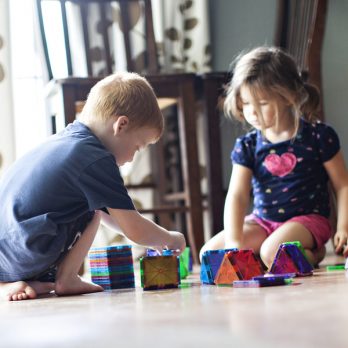
While preschoolers have their own interests, those can (and do) change frequently, so what your child wants shouldn’t influence what you buy too much. (In the coming years, though, your child will probably be more insistent about the types of toys he wants.) When shopping, think more holistically about the toys in your house. Do you have a wide variety of toys, games, and puzzles? Having a diverse assortment of age-appropriate toys will help your child learn new things every day and be ready to take on new challenges. Toys with many pieces are always a good bet for encouraging sharing behaviors. A big set of blocks, Wedgits, or Magna Tiles can keep a roomful of children occupied for hours. As the pieces get smaller and cleaning up gets harder, implement an efficient playroom organizational system. Store some toys and rotate a select few that you can maintain. Just remember that a great toy is one that children will interact with in creative ways, and one that they will come back to again and again for many years.

28Feb2019

Dealing with Childhood Fears and Phobias

My daughter has always been a little more on the sensitive side. It takes her a while to warm up to new environments, people, and situations. That’s why I think her transition to child care was so challenging for me, knowing that she was having such a hard time at first. She had the same struggle with her swim lessons—now she really enjoys the class, but still hesitates at the start of each 30-minute session.

Honestly, as her parent, I’ve always considered it more of a benefit, since I know I can trust her (for the most part) to slowly climb off the couch rather than launching herself off it. Or maybe I have a false sense of trust—let’s hope not! But this so-called perk started to take a turn for the worse. Kayla started to use the word scared, and would tell us when she was scared and what she was scared of. Suddenly, she proclaimed fear of everything: she was scared of the sound of distant sirens of an emergency vehicle, of the ants on the ground, the bumblebees at the park, and of the ceiling fan in our home.

After doing some research, it seems these are some helpful tips for dealing with childhood fears and phobias:

  • Don’t smile at the fear, even if you think it’s cute
  • Acknowledge the fear so they know it’s appropriate to have fears
  • Explain and talk it out

While this all made sense upon my first time reading it, I found myself returning to do more research with new fears popping up almost daily. Has this become a way to get more attention or snuggle time with mom and dad? Is it something we should be concerned about? How have you dealt with your child’s fears and phobias?

25Feb2019

The 11 Best Books for Babies

Short winter days mean longer, cozier evenings — the perfect time to curl up with your baby and a book. But which book should you choose? Board and wooden books that are easy for your baby to hold, are rich in color, and have large but limited text are best. And we’ve got a list of recommended titles from the Bright Horizons® Growing Readers program that will quickly become new favorites. Take a look:

One Foot, Two Feet, written and illustrated by Peter Maloney and Felicia Zekauskas: This counting-to-ten book introduces numbers and shows one object — a foot, a mouse, a goose — compared to a group of that same object.

Touch Think Learn Shapes, written by Xavier Deneux: This colorful, interactive book takes babies on a hands-on, shape-filled adventure. As you read, you can help your baby trace each shape with his or her finger.

I Like Vegetables, written and illustrated by Lorena Siminovich: Explore vegetables of different shapes and colors, learn about opposites, and encourage your baby to discover each vegetable’s texture in this touch-and-feel book.

Little Bitty Friends, written by Elizabeth McPike; illustrated by Patrice Barton: The rhyming verses and vibrant illustrations will help introduce your baby to language concepts and elements of the natural world, such as ants, a caterpillar, and flowers.

Thank You!, written and illustrated by Ethan Long: “Bark, bark!” “Hum, hum!” This book includes fun, cartoon-like pictures of animals saying “thank you” in their own ways. Your baby will see different shapes, colors, and objects and will hear many different animal sounds.

Hello, Day!written and illustrated by Anita LobelMore animal sounds, combined with large, bright illustrations will introduce babies to meows, moos, and more.

Tuck Me In!, written by Dean Hacohen, illustrated by Sherry Scharschmidt: This is a great book to read with your little one before naptime or bedtime. Go through each page with your baby and fold over the blankets until all of the animals — the zebra, peacock, hedgehog, and more — are ready to go to sleep. As your baby gets older, encourage him or her to help you fold the blankets over. This book will introduce new animal names and will also help with fine motor development.

Peck, Peck, Peck, written and illustrated by Lucy Cousins: Babies will enjoy the bright colors and illustrations throughout this book, and they can stick their fingers through the holes made by pecking woodpeckers.

Ten Little Fingers and Ten Little Toes, written by Mem Fox, illustrated by Helen Oxenbury: This book takes a rhythmic approach to introduce fingers and toes. Babies will see beautiful watercolor illustrations that mimic their own fingers, toes, and bodies, and they’ll hear different numbers, too.

Me Baby, You Baby, written and illustrated by Ashley Wolff: Rhyming phrases create a story of two mothers and their babies who start their day, get ready for an adventure, and head off to the zoo.

Machines at Work, written and illustrated by Byron Barton: This simple introduction to construction includes bold illustrations of big machines, a lot of color, and just a few words per page.

Reading with your baby can be a fun bonding experience for both of you, and it can boost brain and language development and spark a love of books, too. Get started with these 11 titles!

18Feb2019

From breakfast in bed to backward dinners and flashlight walks, surprise your kids with magical moments they’ll be talking about for weeks.

Adding something special to your child’s day doesn’t have to be expensive or time-consuming. Surprise your kids with one of these offbeat activities that your little ones will be talking about for months. Who knows? You might create a new family tradition.

1. Backward dinner

Tonight, serve dessert first! Don’t stress about ruining their appetite; it’s only one meal.

2. Pyjama day

Let your kids wear their comfy PJs all day long, no matter what is planned.

3. Rude dinner

Encourage your kids to break all the mealtime rules. They can eat with their mouths open, forgo cutlery, blow bubbles in their milk, put their elbows on the table—and not worry about muttering a please or thank you.

4. Treat hunt

If they want sweets, they’ll have to work for them! After dinner, send your kids on a scavenger hunt around the house to find dessert.

5. Breakfast in bed

Once a month, serve your kids their favorite morning meal in bed. (Try to be zen about crumbs and spills.)

6. Go camping at home

Have a picnic on the kitchen floor for dinner and then sleep together as a family in a fort or tent in the living room.

7. Ice cream soup!

Give each kid a bowl of ice cream and a bunch of ingredients—caramel sauce, mini marshmallows, sprinkles, chocolate chips—and let them mix it all up into a soupy delight.

8. Play hooky

Pick your kids up from school early and take them to an afternoon movie. Don’t tell them in advance: A surprise is that much more magical. (Sorry, teachers!)

9. Take a trip

Bring them to an extra-special playground or sledding hill—even if it’s on the other side of town.

10. Movie party

Have a family movie night, complete with a blow-up air mattress, tons of pillows and blankets, popcorn and candy.

11. Flashlight walk

Bundle up, give everyone a flashlight and take a post-dinner stroll.

15Feb2019

It seems to come so naturally to talk to your baby, toddler or preschooler about how they are made. In fact, the opportunities seem as endless as the pile of laundry that lies before you. I remember talking to my girls about their bodies as I changed their diapers or bathed them or as we danced around the kitchen island.

But as my girls have grown up, I’ve noticed that it gets exponentially harder to talk about how they are made. Usually, this is because I’m no longer changing their diaper (thank God!) or helping them take a bath. But sometimes it’s harder because our kids start to realize that they don’t like how they are made. Maybe they don’t like the fact that they are smaller or less skilled in athletics. Or maybe they’ve been made fun of because of their appearance or personality. It’s hard to like how you are made when someone makes fun of you. Or it’s hard to talk about how they are made because quite frankly you don’t like who your child is becoming these days (hello, 14-year-olds). So many factors make it more difficult to see how your kids were made on purpose and for a purpose. And it’s hard to help our kids see that, too.

But noticing and commenting on how they are made is crucial to their confidence. They need to know that they were made on purpose. They need to know that they have value apart from anything external—that they have value simply because they were made.

But how do we do this? How can we build confidence in our kids about how they were made?

1. Pay attention.

Go out of your way to be a notice. Pay attention to how your child was made and take note of it. It’s easy to get caught in noticing all the ways of correction or all the ways your child needs to improve. But it’s not so easy to notice all the good (especially if that child pushes all your buttons). Instead of being annoyed that she literally stops to smell the flowers, pay attention to the fact that she was created to notice the beauty in the ordinary. Or notice how she loves people, which is why she wants to talk to every person she passes. Practice being a student of your child—not for the purpose of seeing what needs to improve but for the purpose of seeing the unique ways your child was made on purpose.

2. Say it out loud.

After you have noticed how your child was made, share it. It could be as simple as “I love your smile.” “Thanks for being so helpful.” “You are so strong to endure running 3 miles in PE.” If this feels forced to you, think about what you wish someone would notice about you. And then, use that to help you speak affirming words over your child.

Dr. Deborah Tillman, America’s Super Nanny, recently said on the Surviving Sarah podcast that every night she would sit down with her son at bedtime and say to him, “I see greatness in you.” Then, she would speak something specific to him, and then ask him to say one great thing about himself. That is powerful! How much more confidence would your child (or even yourself) have if they heard every night that there is something great in how they were made?

3. Say it often.

I think it is safe to say that most of us don’t hear many positive words about who we are on a regular basis. Research has shown that for every 1 positive word we hear 5 negative words. We are quite literally starved of positive affirmation. So imagine how needed it is for our kids to hear positive affirmation about how they were made on purpose and for a purpose as they progress through development. So commit to saying something positive about how your child was made every day. Maybe it’s every morning before they leave for school. Or maybe you could leave a note in their lunchbox or on the dashboard of their car or on their bathroom mirror.

Notice the good. Say it out loud and often. Doing that will build confidence in your kids that they were made on purpose and for a purpose. And along the way, it will change your perspective towards your kids. You’ll find that you notice the good things more than the things that need improvement.

8Feb2019

STEM Learning at Home Activity for Kids: Building Bridges

Children at Bright Horizons preschools learn that STEM (science, technology, engineering, and math) is all around us – at school and at home.

Watch as Sarah explains how to conduct the “Building Bridges” learning activity for children. This STEM activity, which only takes 10 minutes to complete and is best suited for a toddler or preschool-aged children, will teach your child about engineering, math and the force of gravity. You only need two items to complete this activity: a book about bridges or one that incorporates bridges (Sarah suggests The Three Billy Goats Gruff) and a set of blocks with varying shapes. Watch now:

STEM Learning at Home: Building Bridges